
Peptides vs. Proteins: What’s the Difference?
By Kinetix Research Editorial Team · Published October 10, 2026 · 2 min read
Quick Answer
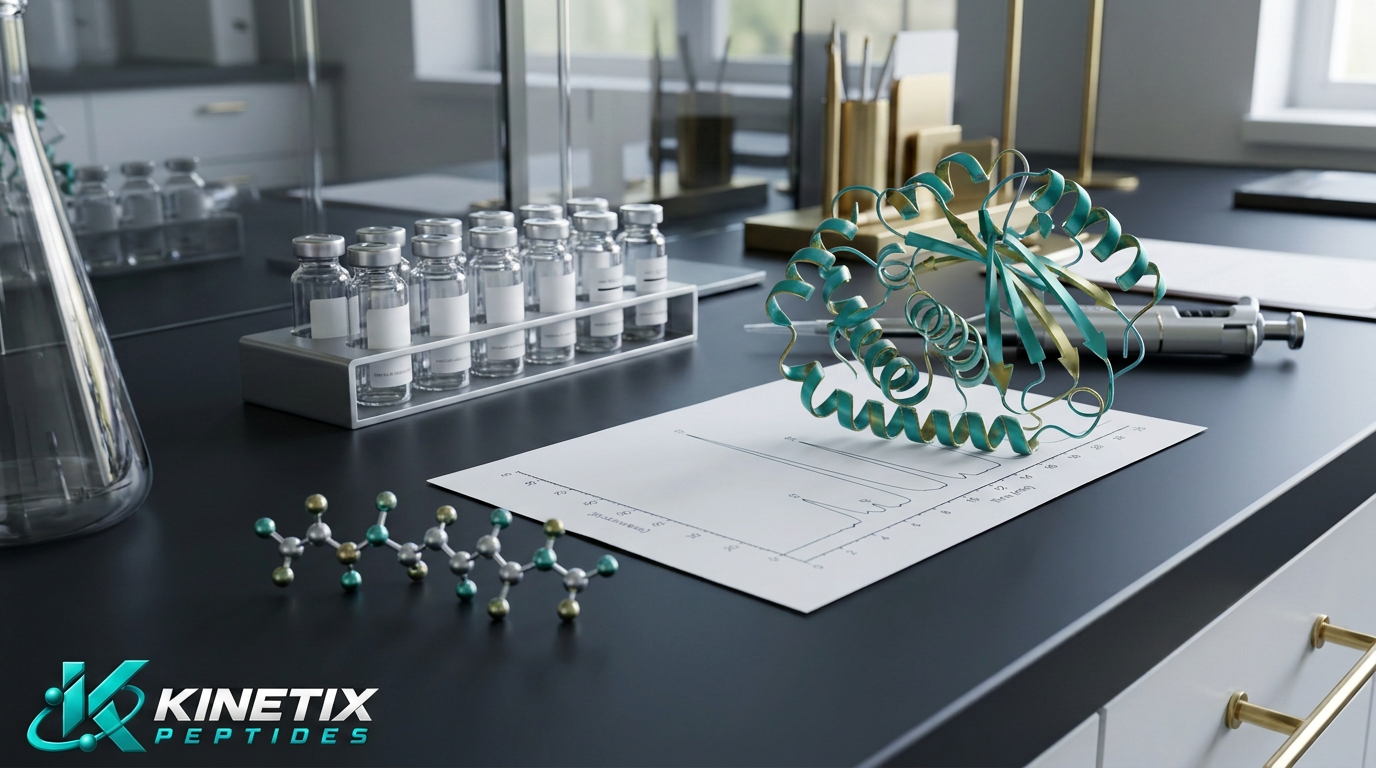
Peptides and proteins both contain amino acid chains connected by peptide bonds. Peptides usually refers to shorter chains, while proteins generally refers to larger polypeptides with organized structures. There is no universal residue-count boundary, and size alone does not determine function or safety.
Key Takeaways
- Peptides and proteins share the same basic chemical linkage.
- The dividing line is a naming convention, not a sharp chemical boundary.
- Some peptides fold, and not every protein is fully structured.
- Biological role depends on sequence and structure, not just length.
The same building blocks
Both peptides and proteins are built from amino acid residues joined by peptide bonds. Their sequences encode chemical features such as charge and hydrophobicity. This shared foundation explains why the terms can overlap, particularly for molecules of intermediate size.
Where the terminology differs
In common usage, peptide often describes a relatively short chain. Protein is usually used for a larger polypeptide or a molecule composed of several polypeptide chains. IUPAC’s Gold Book describes proteins as polypeptides generally above approximately 10,000 daltons, while emphasizing that this limit is not precise.
A frequent shortcut draws a line at 50 amino acids. That can be helpful in a beginner’s discussion, but it is not a universal definition. Molecular weight, sequence, modifications and scientific convention also influence naming.
| Feature | Peptides | Proteins |
|---|---|---|
| Building blocks | Amino acid residues | Amino acid residues |
| Typical size | Shorter chains | Larger polypeptides |
| Structure | May be flexible or folded | Often folded, sometimes partly disordered |
| Naming boundary | No universal cutoff | Conventional, not chemically absolute |
Folding and organization
Many proteins adopt complex three-dimensional structures stabilized by interactions among residues. Some also contain multiple chains. Short peptides can have defined shapes as well, especially when cyclized or stabilized by chemical links. Conversely, some proteins contain intrinsically disordered regions. “Peptides have no structure” is therefore an inaccurate simplification.
Function does not follow size alone
Both families can participate in binding, signaling and other biological processes. Many proteins perform catalytic or structural roles, while some peptides act as signaling molecules. These are examples, not exclusive assignments. A chain’s activity has to be established experimentally for the specific sequence.
Why the distinction matters in research
Chain size and structure can influence synthesis, purification and analytical methods. A research protocol should specify the actual molecule rather than rely solely on the category name. Appropriate identity, purity and experimental controls remain important whether the sample is described as a peptide or a protein.
Neither the word peptide nor protein establishes suitability for human use. Kinetix research materials are not for human consumption.
Frequently asked questions
Is a polypeptide always a protein?
Not necessarily. Polypeptide describes an amino acid chain; protein naming also reflects size and scientific convention.
Are peptides always simpler than proteins?
They are often shorter, but modifications, folding and interactions can still make a peptide chemically complex.
References
- Peptides, IUPAC Gold Book, International Union of Pure and Applied Chemistry
- Proteins, IUPAC Gold Book, International Union of Pure and Applied Chemistry
Research Disclaimer. Kinetix Research content is for educational and informational purposes only. It is not medical advice and does not describe the safety or effectiveness of any product for human use. All Kinetix products are for research use only. See our disclaimer.
Related research
Peptide Science
What Are Peptides? A Beginner’s Guide to Peptide Science
An introduction to amino acids, peptide bonds and the difference between a molecular category and a proven treatment.
Analytical Testing
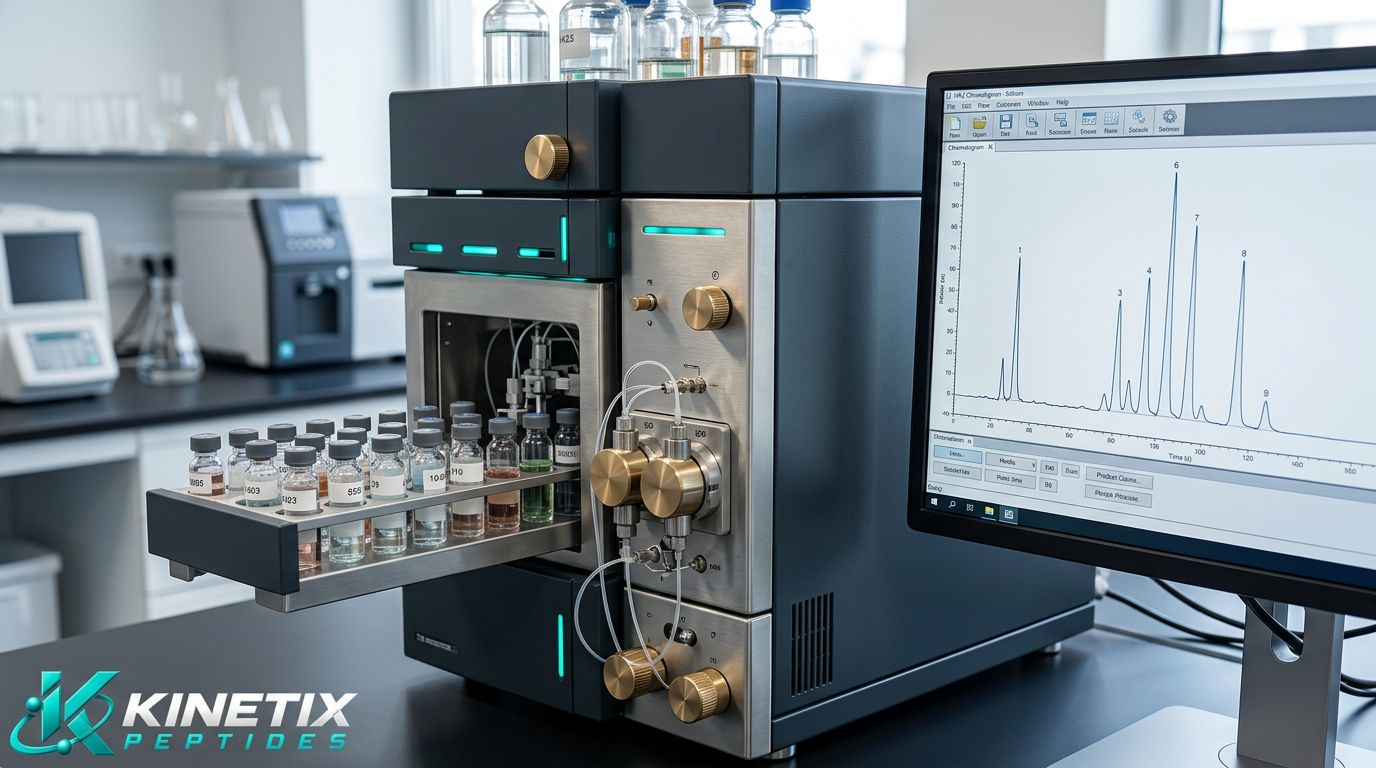
What Is HPLC Testing? A Plain-Language Guide for Peptide Research
How high-performance liquid chromatography separates a sample, what a chromatogram shows, and where its limits are.
Stay Updated on Research
Receive research insights, scientific updates, and educational resources from Kinetix Research.