
What Is HPLC Testing? A Plain-Language Guide for Peptide Research
By Kinetix Research Editorial Team · Published October 11, 2026 · 2 min read
Quick Answer
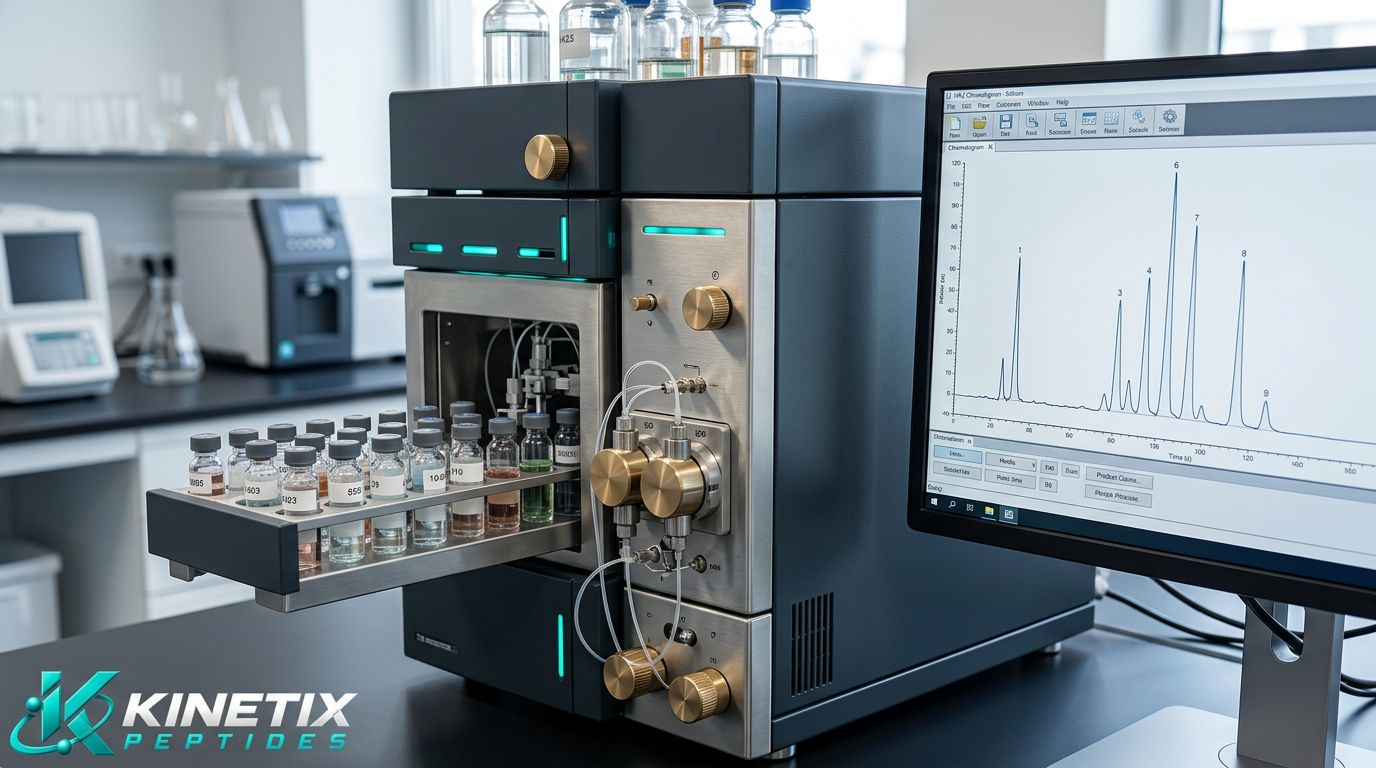
HPLC (high-performance liquid chromatography) is a laboratory method that pushes a dissolved sample through a packed column under pressure. Different components travel at different speeds, so they leave the column at different times and appear as separate peaks. For peptides, HPLC is commonly used to estimate purity: the share of the main peak compared with all detected peaks.
Key Takeaways
- HPLC separates the components of a sample so they can be detected one by one.
- Purity by HPLC is usually reported as the main peak's area as a percentage of total peak area.
- HPLC alone does not confirm a compound's identity, that is typically done with mass spectrometry.
- Results depend on the method used, so methods are validated before they are relied on.
How HPLC works
A small amount of dissolved sample is injected into a liquid stream (the mobile phase) that flows through a column packed with fine particles (the stationary phase). Each component interacts with the column slightly differently, so components exit at different times. A detector, often measuring UV absorbance, records a signal as each component passes.
For peptides, reversed-phase HPLC is the most widely used mode. It separates molecules mainly by how hydrophobic they are, and a gradient of increasing organic solvent is used to move them off the column.
Reading a chromatogram
The output is a chromatogram: a graph of detector signal over time. Each peak represents one or more components. The time a peak appears is its retention time; the area under it relates to how much of that component is present.
| Term | What it means |
|---|---|
| Retention time | When a component leaves the column, in minutes |
| Peak area | Size of the signal, used to compare amounts |
| Area % | A peak's area as a share of all detected peak area |
| Wavelength | The UV setting used by the detector (e.g. 214–220 nm for peptide bonds) |
What HPLC does not tell you
- Identity: two different molecules can have similar retention times. Identity is normally confirmed with mass spectrometry.
- Undetected material: substances that do not absorb at the chosen wavelength, such as water or salts, may not appear as peaks.
- Net content: area % purity is not the same as how much peptide is in a vial by weight.
Why method validation matters
International guidance such as ICH Q2(R2) describes how analytical procedures should be validated, for example for specificity, accuracy, precision and range, so that results are reliable for their intended purpose. General chromatography practice is described in USP General Chapter <621>.
This article is educational and describes general laboratory practice. It is not medical advice.
Frequently asked questions
Does 99% HPLC purity mean the vial is 99% peptide?
Not exactly. It means the main peak made up about 99% of the detected peak area under that method. Water, counter-ions and salts are not counted, so net peptide content by weight can be lower.
Is HPLC enough to confirm what a peptide is?
No. HPLC is used for purity; identity is typically confirmed by mass spectrometry, which measures molecular mass.
References
- ICH Q2(R2) Validation of Analytical Procedures, International Council for Harmonisation (ICH)
- General Chapter <621> Chromatography, United States Pharmacopeia (USP)
Research Disclaimer. Kinetix Research content is for educational and informational purposes only. It is not medical advice and does not describe the safety or effectiveness of any product for human use. All Kinetix products are for research use only. See our disclaimer.
Related research

Analytical Testing
Understanding Peptide Purity: What the Percentage Does, and Does Not, Tell You
Purity figures are useful, but only when you know how they were measured and what they leave out.
Research Documentation
How to Read a Certificate of Analysis (CoA)
A section-by-section walkthrough of the document that records a batch's test results.
Stay Updated on Research
Receive research insights, scientific updates, and educational resources from Kinetix Research.