
What Is GHK-Cu? Exploring Copper Peptides and the Science Behind Them
By Kinetix Research Editorial Team · Published October 10, 2026 · 2 min read
Quick Answer
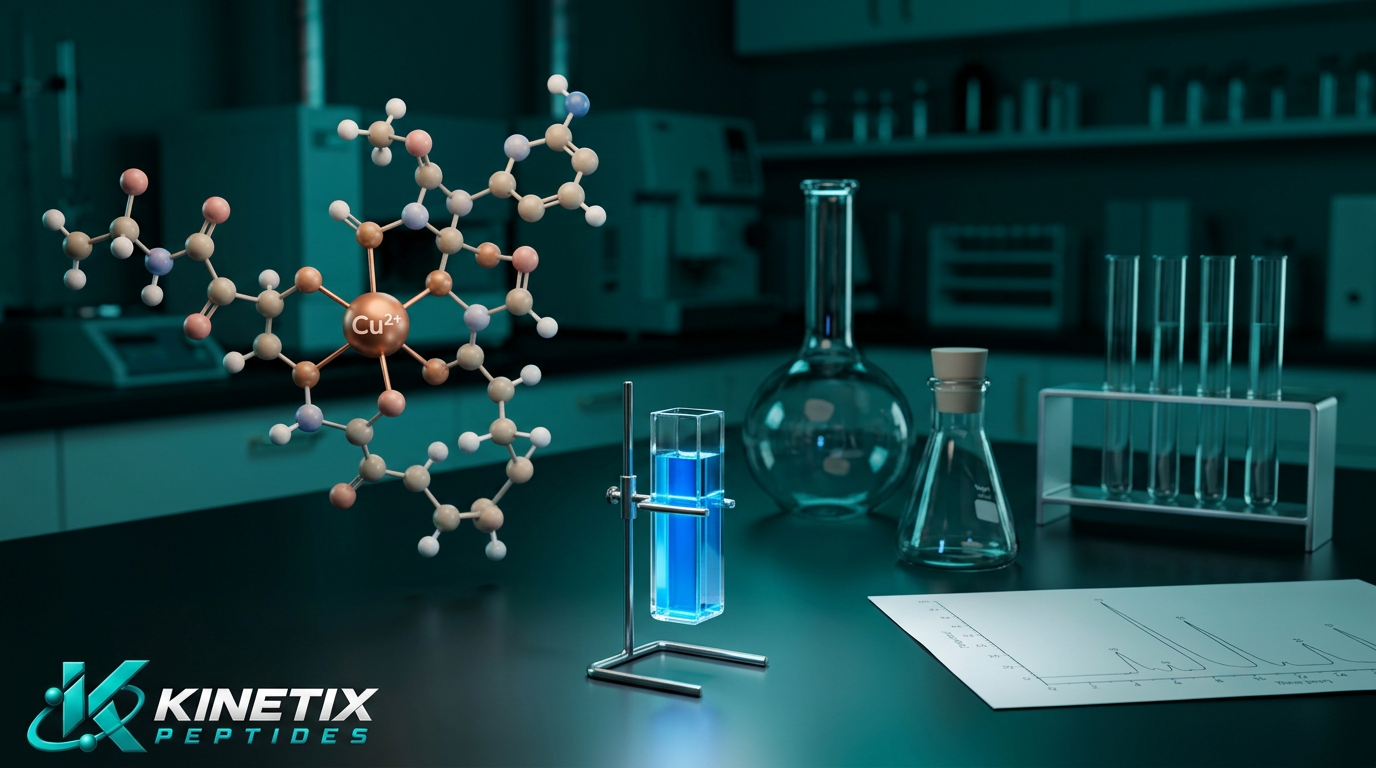
GHK-Cu is a copper complex of the tripeptide glycyl-L-histidyl-L-lysine. Researchers have studied it in cell, animal and skin-related settings. Copper binding changes its chemical behavior, but mechanistic or topical findings do not establish the safety or effectiveness of research-only GHK-Cu for other uses.
Key Takeaways
- GHK consists of three amino acid residues, glycine, histidine and lysine.
- GHK-Cu refers to GHK complexed with copper.
- Evidence must be read in the context of its model and formulation.
- Cosmetic, preclinical and clinical evidence are not interchangeable.
What GHK-Cu is
GHK is the sequence glycine-histidine-lysine, often written as glycyl-L-histidyl-L-lysine. It can bind copper ions, producing the complex known as GHK-Cu. The peptide and the copper complex are related but not identical chemical forms. Researchers should therefore check which form an experiment used.
Why copper binding matters
Copper is involved in several biological processes, and coordination to a peptide changes how the metal interacts with its surroundings. GHK-Cu has drawn interest in studies of cellular signaling and extracellular matrix biology. The role of copper in normal physiology does not mean that any copper-containing preparation is beneficial or safe.
What published research explores
A 2018 review by Pickart and colleagues discusses GHK-Cu findings involving gene-expression data and tissue-related experimental systems. Such reviews are useful maps of a field, but they combine studies with different methods and evidence strengths. A change in gene expression is not itself a demonstrated clinical outcome.
Skin-related or topical observations must be distinguished from systemic exposure. Formulation, concentration, study population and measured endpoints can differ substantially. Findings from one setting cannot automatically support claims for a different use.
Questions to ask about a GHK-Cu study
| Question | Why it matters |
|---|---|
| Was GHK or GHK-Cu studied? | Chemical form can affect behavior |
| Cell, animal or human study? | Model determines what conclusions are justified |
| Topical or another formulation? | Exposure and formulation affect relevance |
| Mechanism or clinical outcome? | A laboratory signal is not a proven health benefit |
Analytical documentation still matters
A research sample needs appropriate identity and quality information. HPLC area percentage is not a complete description of copper content, net peptide content or every possible contaminant. Read batch-specific documentation rather than assuming a product name or blue color confirms composition.
This article makes no anti-aging, wound-healing or treatment claim about Kinetix materials. GHK-Cu content should receive regulatory review before use in advertising.
Frequently asked questions
Is GHK-Cu the same as GHK?
No. GHK is the tripeptide; GHK-Cu is its copper complex. Studies should specify which chemical form they tested.
Do topical findings prove safety for other uses?
No. Evidence is specific to the formulation, exposure and study design. It should not be extrapolated to unrelated uses.
References
- Regenerative and Protective Actions of the GHK-Cu Peptide in the Light of the New Gene Data, Pickart, Vasquez-Soltero and Margolina, International Journal of Molecular Sciences, 2018
- Peptides, IUPAC Gold Book, International Union of Pure and Applied Chemistry
Research Disclaimer. Kinetix Research content is for educational and informational purposes only. It is not medical advice and does not describe the safety or effectiveness of any product for human use. All Kinetix products are for research use only. See our disclaimer.
Related research
Peptide Science
What Are Peptides? A Beginner’s Guide to Peptide Science
An introduction to amino acids, peptide bonds and the difference between a molecular category and a proven treatment.

Scientific Literacy
Are Research Peptides Safe? What Science Can and Cannot Tell Us
How to distinguish analytical quality from human safety, and why research evidence cannot be reduced to a yes-or-no promise.

Analytical Testing
Understanding Peptide Purity: What the Percentage Does, and Does Not, Tell You
Purity figures are useful, but only when you know how they were measured and what they leave out.
Stay Updated on Research
Receive research insights, scientific updates, and educational resources from Kinetix Research.