
Understanding Peptide Purity: What the Percentage Does, and Does Not, Tell You
By Kinetix Research Editorial Team · Published October 11, 2026 · 1 min read

Quick Answer
Peptide purity is usually the percentage of the target peptide among all components detected by HPLC. It describes how much of the detected material is the intended sequence versus related impurities. It does not on its own describe identity, net peptide content, or the absence of every possible contaminant.
Key Takeaways
- Purity is method-dependent: always check which method and wavelength were used.
- Common peptide impurities include deletion sequences, truncated sequences and oxidized forms.
- Purity (area %) and net peptide content (weight %) are different measurements.
- Identity confirmation by mass spectrometry complements a purity figure.
What purity measures
In synthetic peptide work, purity normally refers to chromatographic purity: the main peak's area divided by the total area of all integrated peaks, expressed as a percentage.
Where impurities come from
Peptides are commonly built one amino acid at a time by solid-phase synthesis. Each step is very efficient but not perfect, so small amounts of related molecules can form.
| Impurity type | Description |
|---|---|
| Deletion sequence | Missing one amino acid from the intended chain |
| Truncated sequence | Chain that stopped growing early |
| Oxidation products | Residues such as methionine that have reacted with oxygen |
| Incomplete deprotection | Protecting groups left attached after synthesis |
Purity vs. net peptide content
A lyophilized peptide powder also contains water and counter-ions (such as acetate or trifluoroacetate). Net peptide content describes how much of the powder's weight is peptide. A sample can have high purity and a lower net content at the same time.
How to evaluate a purity claim
- Is the analytical method named (e.g. reversed-phase HPLC) and the wavelength stated?
- Is the chromatogram included, not just a number?
- Is identity confirmed, for example by mass spectrometry?
- Does the report reference a specific batch or lot number?
Educational content only. Research use only; not for human consumption.
Frequently asked questions
Is higher purity always better for research?
Higher purity reduces the influence of related impurities on results, which is why many research protocols specify a minimum purity. The required level depends on the application.
References
- ICH Q6B Specifications: Test Procedures and Acceptance Criteria for Biotechnological/Biological Products, International Council for Harmonisation (ICH)
- ICH Q2(R2) Validation of Analytical Procedures, International Council for Harmonisation (ICH)
Research Disclaimer. Kinetix Research content is for educational and informational purposes only. It is not medical advice and does not describe the safety or effectiveness of any product for human use. All Kinetix products are for research use only. See our disclaimer.
Related research
Analytical Testing
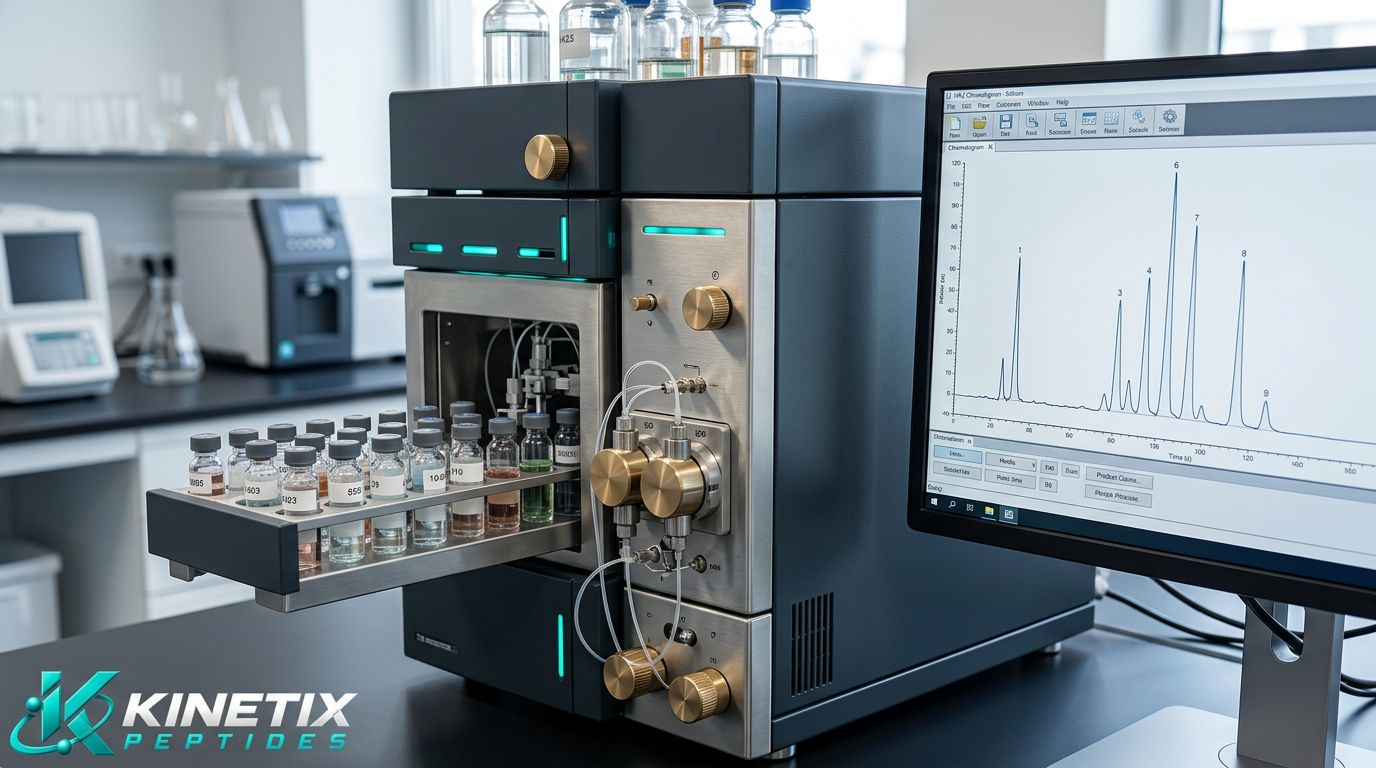
What Is HPLC Testing? A Plain-Language Guide for Peptide Research
How high-performance liquid chromatography separates a sample, what a chromatogram shows, and where its limits are.
Research Documentation
How to Read a Certificate of Analysis (CoA)
A section-by-section walkthrough of the document that records a batch's test results.
Stay Updated on Research
Receive research insights, scientific updates, and educational resources from Kinetix Research.