
If Two Peptides Have Exactly the Same Amino Acid Sequence, Can They Still Be Different?
By Kinetix Research Editorial Team · Published October 9, 2026 · Updated October 14, 2026 · 2 min read
Quick Answer
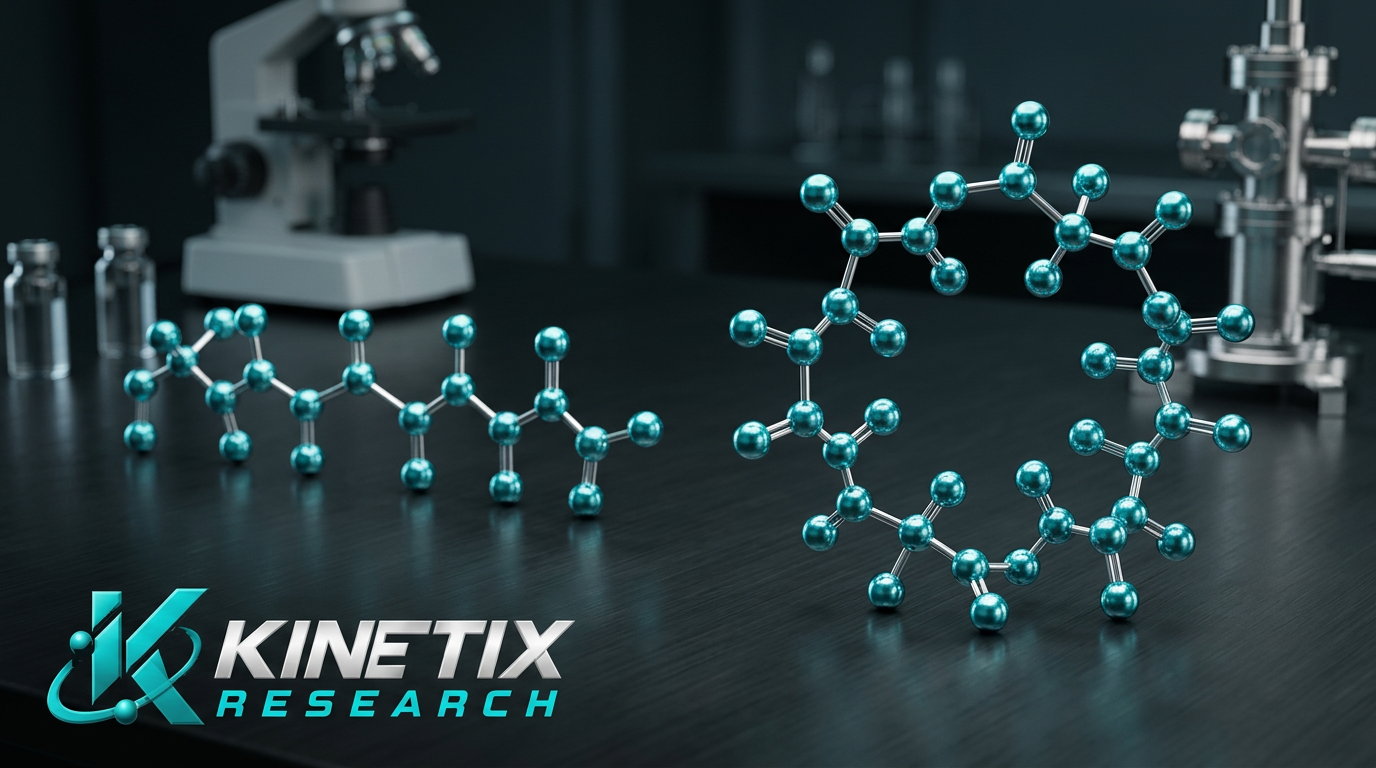
Yes. A conventional amino acid sequence may omit stereochemistry, terminal modifications, cross-links or cyclization, so two peptides with the same written sequence can be chemically different. Even chemically identical molecules can adopt different conformations or occur in samples with different salts, impurities and aggregation states. If complete covalent structure and stereochemistry match, they are the same chemical species, not necessarily equivalent samples.
Key Takeaways
- A sequence is not always a complete chemical specification.
- D/L configuration, end groups and cross-links can change identity.
- Conformation and sample composition are different from covalent identity.
- Matching mass alone does not resolve every structural difference.
What does an amino acid sequence actually specify?
A sequence usually records the order of residues from the N-terminus to the C-terminus. That is essential information, but a short letter string does not necessarily describe everything attached to the chain or how its atoms are arranged in three dimensions. Researchers should distinguish the same written sequence from the same fully specified molecule.
For example, a sequence written without terminal annotations may describe a chain with a free carboxyl group or a C-terminal amide. Those are different chemical structures. Likewise, a head-to-tail cyclic version connects the ends of a chain that would otherwise remain linear. The residue order can be recognizably related while the complete identity differs.
Which differences can a sequence label miss?
| Feature | Why it matters |
|---|---|
| Stereochemistry | D- and L-residues arrange atoms differently in space; ordinary letters may not disclose this. |
| Terminal groups | Acetylation or amidation changes chemical structure and can change charge. |
| Cyclization and disulfides | Connectivity constrains the chain and can change the shapes available to it. |
| Attached groups | Lipids or other modifications can change interactions and distribution. |
| Counter-ions and water | These change sample composition without necessarily changing the peptide's covalent structure. |
Stereochemistry is particularly important because biological targets are three-dimensional. A D/L change can alter the orientation of a side chain even when the nominal molecular mass is unchanged. The magnitude and direction of a functional effect depend on the particular peptide; neither better binding nor improved stability follows automatically.
Can identical peptide molecules behave differently?
Yes, because molecular identity is not the whole experimental system. An identical peptide may populate different conformations in different solvents or at different pH values. It may also associate into aggregates. These are state-dependent behaviors, not proof that the underlying covalent structure has changed.
Two supplied samples can additionally differ in peptide content, residual solvent, counter-ion composition or degradation products. A comparison therefore needs both a complete structural specification and suitable characterization of the actual lots being studied.
How do researchers check whether the peptides are equivalent?
- Compare residue order, D/L annotations, terminal groups and all stated modifications.
- Check expected mass and use appropriate fragmentation or other structural evidence where needed.
- Use methods capable of resolving the specific suspected difference; intact mass cannot distinguish all isomers.
- Compare sample preparation, concentration, impurity profile and experimental conditions.
The practical conclusion is not that a sequence is unreliable. It is that the amount of detail in a specification should match the question. A simple sequence may be sufficient for a broad introduction, while a reproducible binding or stability experiment usually needs substantially more information.
Frequently asked questions
Can D- and L-peptides have the same mass?
Yes. Changing stereochemistry does not necessarily change elemental composition or molecular mass, so ordinary intact-mass matching may not distinguish them.
Does different folding always mean a different peptide?
No. The same chemical species can adopt multiple conformations. A changed covalent structure or stereochemistry is a different question.
Does matching a sequence prove two batches are equivalent?
No. Batch equivalence also depends on composition, analytical characterization and the conditions relevant to the experiment.
References
- Reference Standards to Support Quality of Synthetic Peptide Therapeutics, Pharmaceutical Research / United States Pharmacopeia, 2023
- Stereochemical inversion of a peptide's backbone exemplified by glucagon, Communications Chemistry, 2019
Research Disclaimer. Kinetix Research content is for educational and informational purposes only. It is not medical advice and does not describe the safety or effectiveness of any product for human use. All Kinetix products are for research use only. See our scientific disclaimer and editorial policy.
Related research
Peptide Science
Why Can Changing Just One Amino Acid Dramatically Alter a Peptide's Properties?
Discover how a single amino acid substitution can alter charge, folding, target interactions and degradation, and why the effect depends on its position.

Analytical Testing
Can Mass Spectrometry Identify a Peptide Without Proving That It Is Pure?
Learn what intact mass and tandem mass spectrometry can establish about peptide identity, and why identification is not proof of sample purity.
Peptide Science
What Are Peptides? A Beginner’s Guide to Peptide Science
An introduction to amino acids, peptide bonds and the difference between a molecular category and a proven treatment.
Contact the Kinetix Team
Let's Talk Science.
Have a question about an article or a topic you'd like us to explore? Say Hi to the Kinetix Team.
Stay Updated on Research
Receive research insights, scientific updates, and educational resources from Kinetix Research.