
Why Can Changing Just One Amino Acid Dramatically Alter a Peptide's Properties?
By Kinetix Research Editorial Team · Published October 6, 2026 · Updated October 14, 2026 · 2 min read
Quick Answer
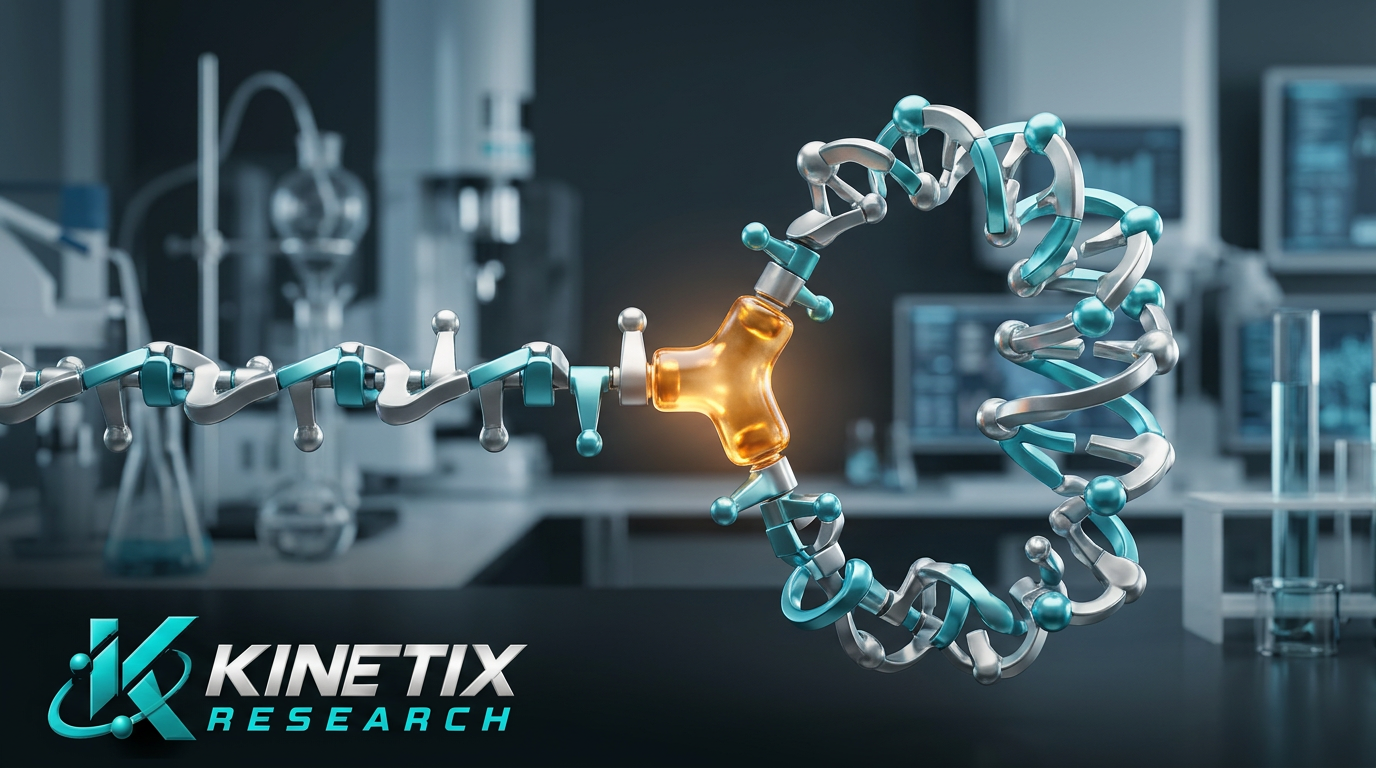
Each amino acid contributes a side chain with particular size, charge, polarity and conformational preferences. Replacing one residue can change a key target contact, reshape the peptide, alter solubility or change susceptibility to enzymes. The effect depends on the substitution and its position; some changes are modest, while others strongly alter measured behavior.
Key Takeaways
- Residues contribute chemistry and shape, not just chain length.
- A change at a key binding contact can matter more than one elsewhere.
- Charge and hydrophobicity can affect both solubility and nonspecific interactions.
- A plausible structural explanation still requires experimental verification.
What does one amino acid contribute?
The peptide backbone connects the chain, while each residue's side chain contributes distinct chemical possibilities. A side chain may carry charge at the experimental pH, favor contact with water, contain an aromatic ring or provide a site for hydrogen bonding. Substituting a residue changes one or more of these features without changing the total residue count.
Position matters because a peptide is not a bag of independent ingredients. A residue at a target interface can help orient the whole chain. A residue that supports a turn can influence which parts of the molecule meet in space. Losing one important interaction can therefore change more than the immediate local contact.
How can one substitution change measured properties?
| Change | Possible consequence |
|---|---|
| Charged residue replaced by an uncharged one | Different net charge and electrostatic interactions at a specified pH. |
| Small side chain replaced by a bulky one | Altered packing or steric compatibility at a binding site. |
| Introduction of proline | Changed backbone conformational preferences; effects depend on the surrounding sequence. |
| Different hydrophobicity | Changed solubility, membrane association or aggregation tendency. |
| Modification near an enzyme recognition site | Changed susceptibility to cleavage under tested conditions. |
Even a conservative substitution is not guaranteed to be neutral. Two chemically similar side chains can differ in geometry enough to affect a tight contact. Conversely, a visually dramatic substitution may have little impact on a particular assay if that position is not important to the measured process.
Does improved binding mean improved overall performance?
No. Affinity is only one property. A modified peptide might bind more tightly but be less soluble, aggregate more readily, enter cells poorly or interact with unintended targets. These trade-offs are why researchers measure several relevant attributes rather than naming a substitution an improvement from one result alone.
A change can also alter the measured signal without improving the intended biological mechanism. Assay interference or general membrane disruption may look like activity in a narrow experiment. Appropriate controls help distinguish a target-related effect from these alternatives.
How do scientists test a single-residue effect?
- Prepare the original and variant with confirmed identity and comparable quality.
- Use matched concentrations, buffer conditions and handling.
- Measure the relevant properties with suitable controls and replicates.
- Compare binding with functional readouts when a biological claim is made.
- Investigate solubility, aggregation or assay interference when they could explain the result.
The scientific value of a substitution study is the comparison it makes possible. A systematic set of variants can reveal which positions support a property, but conclusions remain specific to the sequence, assays and conditions tested. Findings from one peptide do not predict every other peptide's response to the same substitution.
Frequently asked questions
Will changing one amino acid always change activity?
No. The effect depends on the residue, position and measured property; some substitutions have little effect under the tested conditions.
Can a substitution change peptide mass?
Usually different residues have different masses, but some substitutions or stereochemical changes do not create a distinguishable intact-mass change.
Is stronger binding proof of a better medicine?
No. Selectivity, exposure, stability, toxicity and controlled clinical evidence are separate requirements.
References
- Effects of Single Amino Acid Substitution on the Antibacterial Peptide, Peer-reviewed article via Europe PMC
- Designing Formulation Strategies for Enhanced Stability of Therapeutic Peptides, Pharmaceutics, 2023
- Reference Standards to Support Quality of Synthetic Peptide Therapeutics, Pharmaceutical Research / United States Pharmacopeia, 2023
Research Disclaimer. Kinetix Research content is for educational and informational purposes only. It is not medical advice and does not describe the safety or effectiveness of any product for human use. All Kinetix products are for research use only. See our scientific disclaimer and editorial policy.
Related research
Peptide Science
If Two Peptides Have Exactly the Same Amino Acid Sequence, Can They Still Be Different?
Learn why peptide sequence alone may not capture stereochemistry, terminal modifications, cyclization, folding or differences in sample composition.

Scientific Literacy
How Do Scientists Determine Whether a Peptide Interacts with a Specific Biological Target?
Understand binding assays, affinity, selectivity and cellular target engagement, and why observing an effect does not by itself identify its target.
Peptide Science
What Happens to a Peptide Molecule as It Degrades Over Time?
Explore peptide oxidation, deamidation, hydrolysis and physical instability, and how stability-indicating methods track changes over time.
Contact the Kinetix Team
Let's Talk Science.
Have a question about an article or a topic you'd like us to explore? Say Hi to the Kinetix Team.
Stay Updated on Research
Receive research insights, scientific updates, and educational resources from Kinetix Research.