
If a Peptide Is Labeled 99% Pure, What Exactly Makes Up the Remaining 1%?
By Kinetix Research Editorial Team · Published October 8, 2026 · Updated October 14, 2026 · 2 min read
Quick Answer
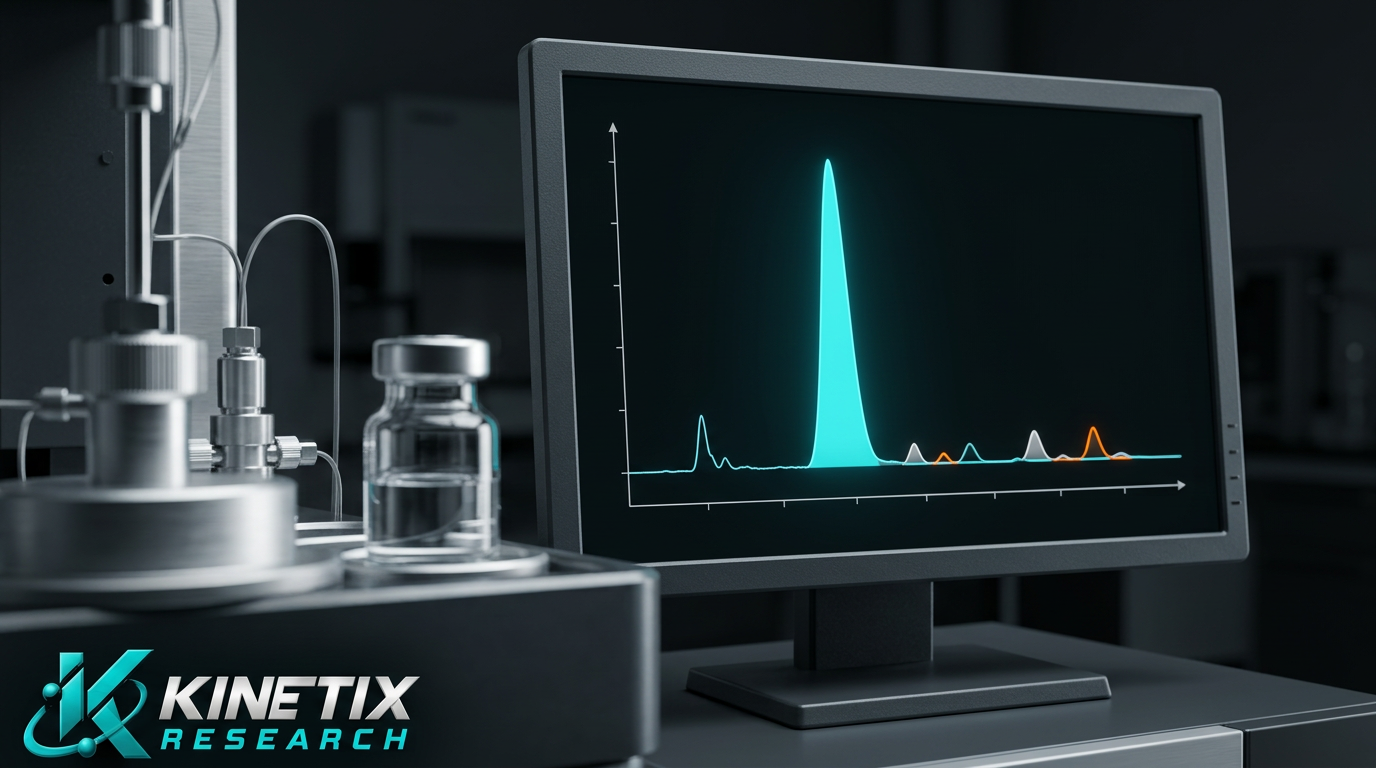
If 99% means HPLC area purity, the remaining 1% is the other integrated detector signal under that method, not a complete inventory of everything in the vial. It may include truncated sequences, synthesis by-products or degradation products, but identifying those components requires additional testing. Water, salts, counter-ions and some contaminants may not be represented in that percentage at all.
Key Takeaways
- The meaning of 1% depends on how purity was measured.
- An impurity peak is evidence of a detected component, not its automatic identification.
- Detector response is not necessarily proportional to mass in the same way for every compound.
- Undetected or co-eluting material can remain outside the reported impurity total.
What is the denominator behind 99% purity?
A percentage needs a defined measurement. In common HPLC-UV area reporting, the laboratory assigns a peak to the intended peptide and divides its area by the sum of the included integrated peak areas. Column conditions, wavelength, peak thresholds and integration rules determine what enters that calculation.
| Signal | Integrated area |
|---|---|
| Assigned peptide peak | 9,900 units |
| Other included peaks | 100 units |
| Total included signal | 10,000 units |
| Other peak area percentage | 100 ÷ 10,000 × 100 = 1% |
The 100 units are detector response. They are not automatically 100 units of material by weight. Components can respond differently at the chosen wavelength, and a contaminant that co-elutes with the main peak may contribute to the area assigned to the peptide instead of forming a separate impurity peak.
Which peptide-related impurities might be present?
Chemical synthesis can leave deletion sequences, incomplete coupling products or incompletely removed protecting groups. Processing and storage may introduce oxidized, deamidated or otherwise altered forms. These are possibilities, not a diagnosis of a particular vial: an area percentage alone cannot establish which molecules are present.
LC-MS can help associate separated peaks with molecular masses, and additional experiments may be needed for ambiguous structures. A report that labels every minor peak simply as impurity has measured extra signal without necessarily establishing its identity or toxicological significance.
What might not appear in the remaining 1%?
- Water and counter-ions that contribute to the weighed material but are not usefully measured by the UV method.
- Residual solvents requiring a suitable separate procedure.
- Components below detection or integration thresholds.
- Species not separated from the main peak.
- Microbiological attributes such as sterility or endotoxin, unless separately tested.
Consequently, neither the 99% nor its complement establishes net peptide content. A sample can have a high relative peptide peak area while containing a substantial amount of water or counter-ion by weight. Appropriate content and composition measurements are needed to make a mass-based statement.
What should a researcher ask the laboratory?
- Is the result area percentage, a calibrated assay or another measurement?
- Which detector and integration rules were used?
- Were minor peaks identified, and was separation adequate?
- Which relevant non-peptide components were tested separately?
The useful question is not merely whether 1% sounds small. It is whether the method detects the impurities relevant to the intended experiment and whether the accompanying data justify the interpretation being made.
Frequently asked questions
Is the remaining 1% always harmful?
No such conclusion follows from the percentage alone. Risk depends on the identity, amount, exposure and context of each component, which an area result does not establish.
Does 99% purity mean 99% of the vial weight is peptide?
Not when the result is HPLC area percentage. Net peptide content and chromatographic area purity are distinct measurements.
Can the main peak contain another compound?
Yes. Co-elution can cause different components to contribute to a single peak unless the method separates or otherwise distinguishes them.
References
- ICH Q2(R2): Validation of Analytical Procedures, International Council for Harmonisation
- Reference Standards to Support Quality of Synthetic Peptide Therapeutics, Pharmaceutical Research / United States Pharmacopeia, 2023
Research Disclaimer. Kinetix Research content is for educational and informational purposes only. It is not medical advice and does not describe the safety or effectiveness of any product for human use. All Kinetix products are for research use only. See our scientific disclaimer and editorial policy.
Related research
Analytical Testing
What Does 99% Peptide Purity Actually Mean?
What chromatographic area percentage measures, a simple calculation, and why purity is not the same as content or safety.
Analytical Testing
Can a Laboratory Report Show High Purity Even When the Sample Has Other Quality Problems?
High chromatographic purity can coexist with incorrect identity, low peptide content or untested contaminants; learn which measurements answer each question.
Analytical Testing
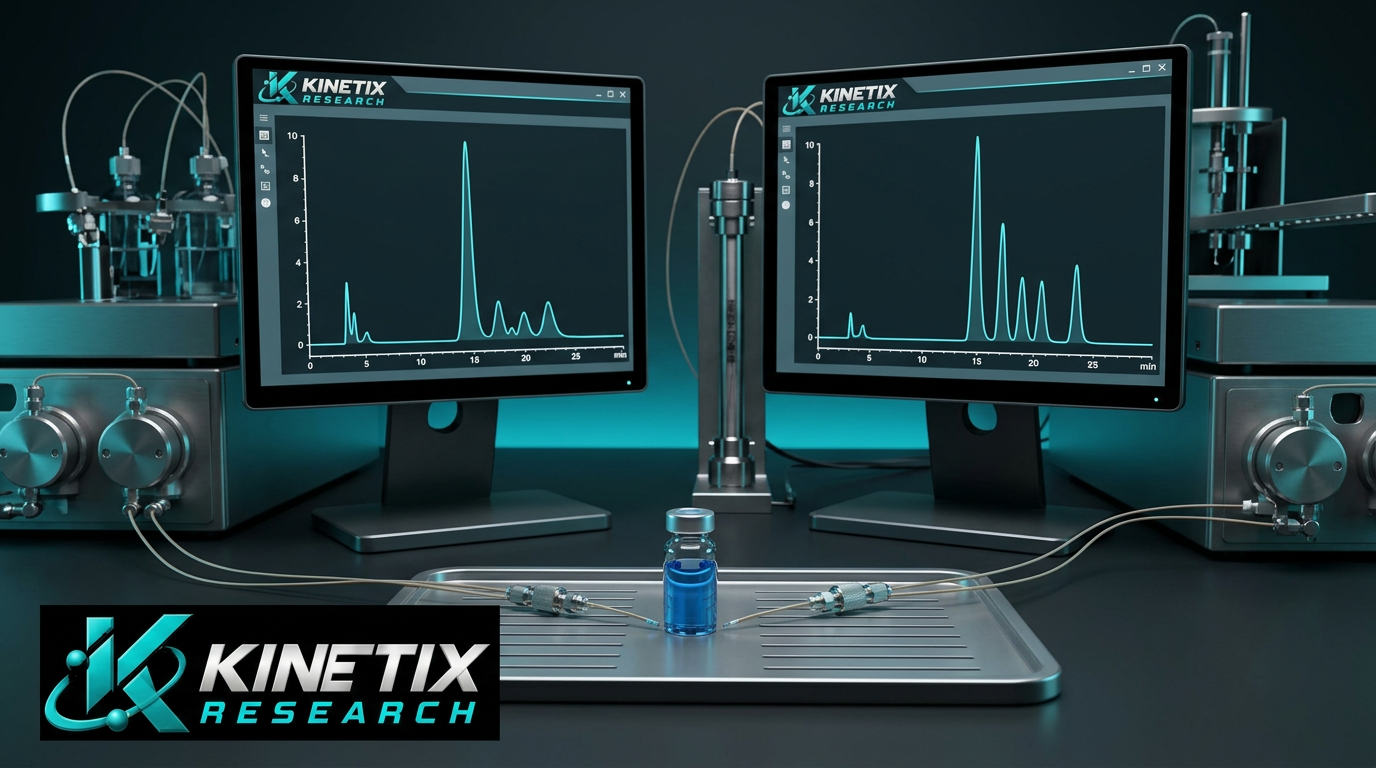
Why Can Two Laboratories Report Different Purity Percentages for the Same Peptide Sample?
Learn how chromatography conditions, detection, peak integration and sample handling can produce different peptide purity results between laboratories.
Contact the Kinetix Team
Let's Talk Science.
Have a question about an article or a topic you'd like us to explore? Say Hi to the Kinetix Team.
Stay Updated on Research
Receive research insights, scientific updates, and educational resources from Kinetix Research.