
Can a Laboratory Report Show High Purity Even When the Sample Has Other Quality Problems?
By Kinetix Research Editorial Team · Published October 7, 2026 · Updated October 14, 2026 · 2 min read
Quick Answer
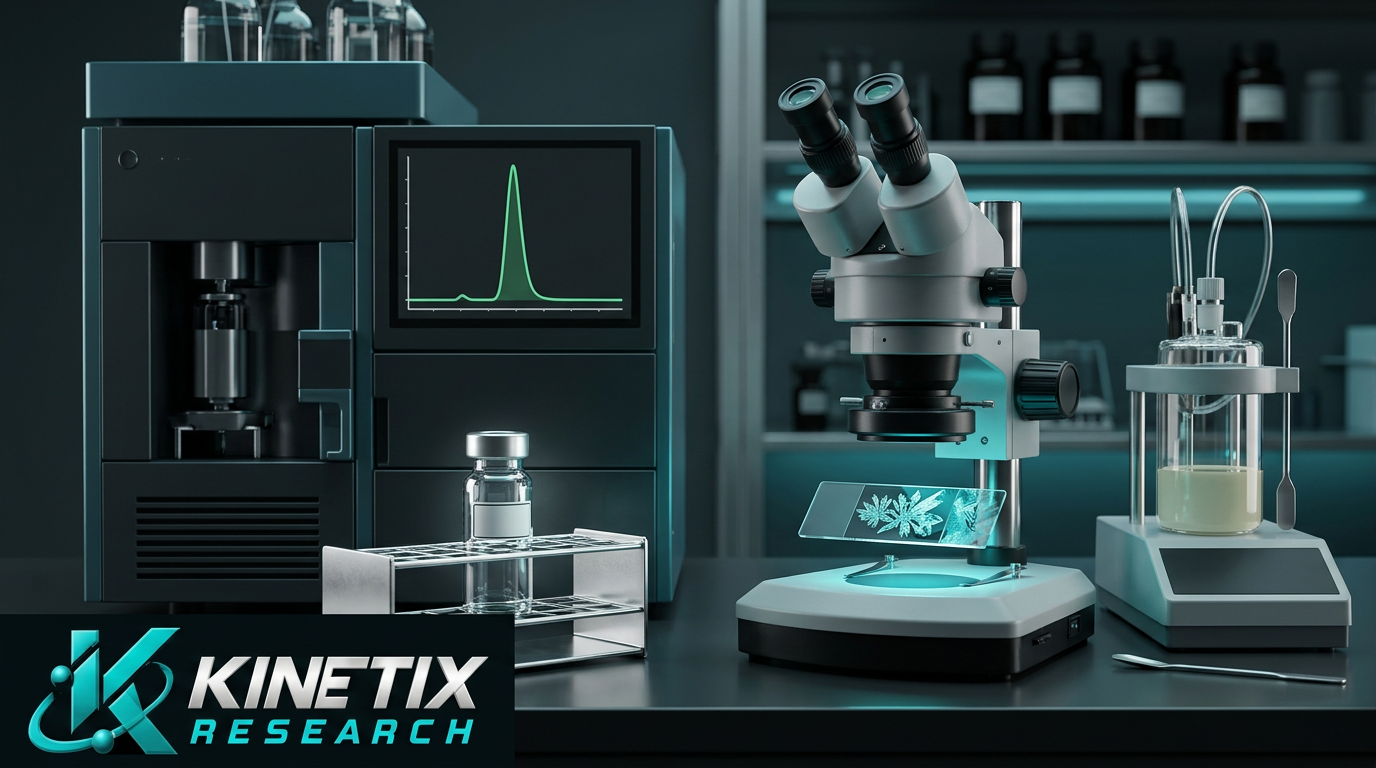
Yes. A high purity result can coexist with incorrect identity, low peptide content, residual solvent, water, aggregation or untested microbiological contamination. Purity describes a specified analytical measurement, not every quality attribute. A meaningful assessment combines identity, content, relevant impurity testing and stability evidence suited to the intended research use.
Key Takeaways
- A clean chromatogram is not a universal quality certificate.
- Identity, content, purity and stability answer different questions.
- An unperformed test is an unknown, not a passing result.
- Quality specifications must be appropriate to the material and experiment.
What does a high purity result actually show?
An analytical method only reports what it was designed and demonstrated to measure. If one detected component dominates a chromatogram, a high area percentage may be justified under that procedure. The result does not by itself identify the component or demonstrate that every relevant contaminant is absent.
Imagine a vial containing the wrong peptide with few detectable related impurities. It could generate a dominant peak and therefore a high relative area result. Identity testing is needed to establish whether the major component is the intended molecule. This is an illustrative scenario, not an allegation about a product or laboratory.
Which quality attributes need separate evidence?
| Attribute | Question being answered |
|---|---|
| Identity | Is the intended chemical species present? |
| Content or assay | How much target material is present under a calibrated procedure? |
| Purity and impurities | Which relevant additional components are detected and measured? |
| Physical condition | Are aggregation or other physical changes relevant to the experiment? |
| Stability | Do measured properties remain within defined limits over time? |
| Microbiological quality | What do separate appropriate microbiological tests establish? |
Water and counter-ions may contribute to sample weight without producing a corresponding HPLC-UV impurity signal. Residual solvent often needs a different analytical procedure. An aggregate may require suitable size-based or other physical characterization. Choosing a test follows the question, not the attractiveness of a headline number.
Why can a method miss a quality problem?
A detector has finite sensitivity and responds differently to different analytes. Separation can be incomplete, sample preparation can change what reaches the instrument, and a reporting threshold can omit weak signals. Validation assesses whether performance is adequate for the intended purpose; it does not transform one method into a measurement of every possible attribute.
ICH specifications distinguish identity, purity, impurities and other attributes. These drug-development frameworks help explain analytical reasoning but should not be treated as proof that a research supplier or batch complies with pharmaceutical requirements. The applicable specification must be established for the actual context.
How should researchers evaluate overall sample quality?
- Start with a complete identity specification and a traceable lot number.
- Review the method and underlying data behind the reported purity.
- Ask for content and relevant contamination measurements when needed for the experiment.
- Consider storage history and stability evidence rather than relying on a single release result.
- Record untested attributes as unknown instead of assuming they passed.
The strongest interpretation is a scoped one: the sample met the stated acceptance criteria for the tests performed on the sampled material. Extending that statement to human safety, every contaminant or future stability requires evidence that the purity number does not supply.
Frequently asked questions
Can a wrong peptide be highly pure?
Yes. Purity and identity are distinct attributes. A nearly single-component sample can still contain the wrong major compound.
Does HPLC prove sterility?
No. A chromatographic purity method is not a sterility test and does not establish microbiological quality.
Does a higher purity number always mean a better research sample?
Not necessarily. Method comparability, correct identity, content, relevant contaminants and stability also matter.
References
- ICH Quality Guidelines: Q6A and Q6B Specifications, International Council for Harmonisation
- ICH Q2(R2): Validation of Analytical Procedures, International Council for Harmonisation
- Reference Standards to Support Quality of Synthetic Peptide Therapeutics, Pharmaceutical Research / United States Pharmacopeia, 2023
Research Disclaimer. Kinetix Research content is for educational and informational purposes only. It is not medical advice and does not describe the safety or effectiveness of any product for human use. All Kinetix products are for research use only. See our scientific disclaimer and editorial policy.
Related research
Analytical Testing
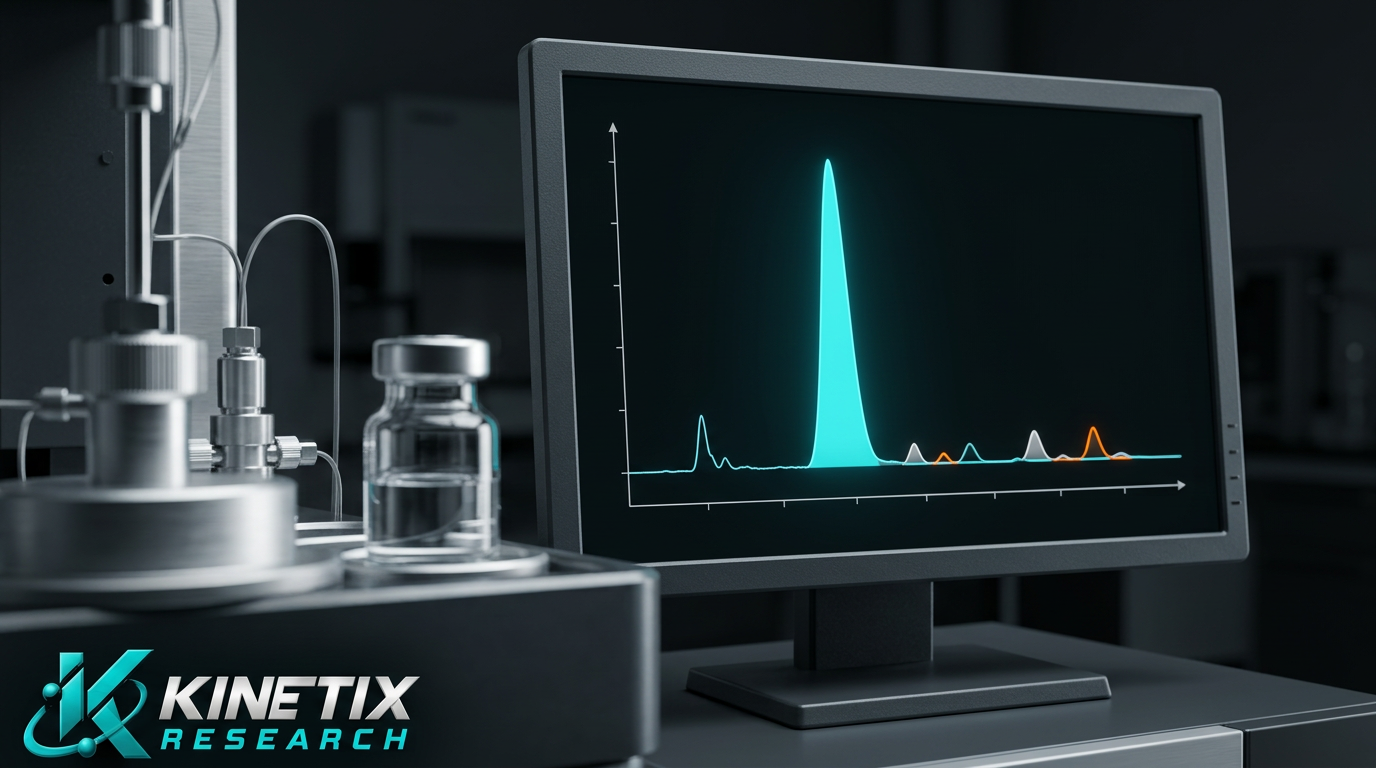
If a Peptide Is Labeled 99% Pure, What Exactly Makes Up the Remaining 1%?
Understand what the remaining 1% of an HPLC purity result represents, which impurities may contribute and why it is not a complete mass balance.
Research Documentation
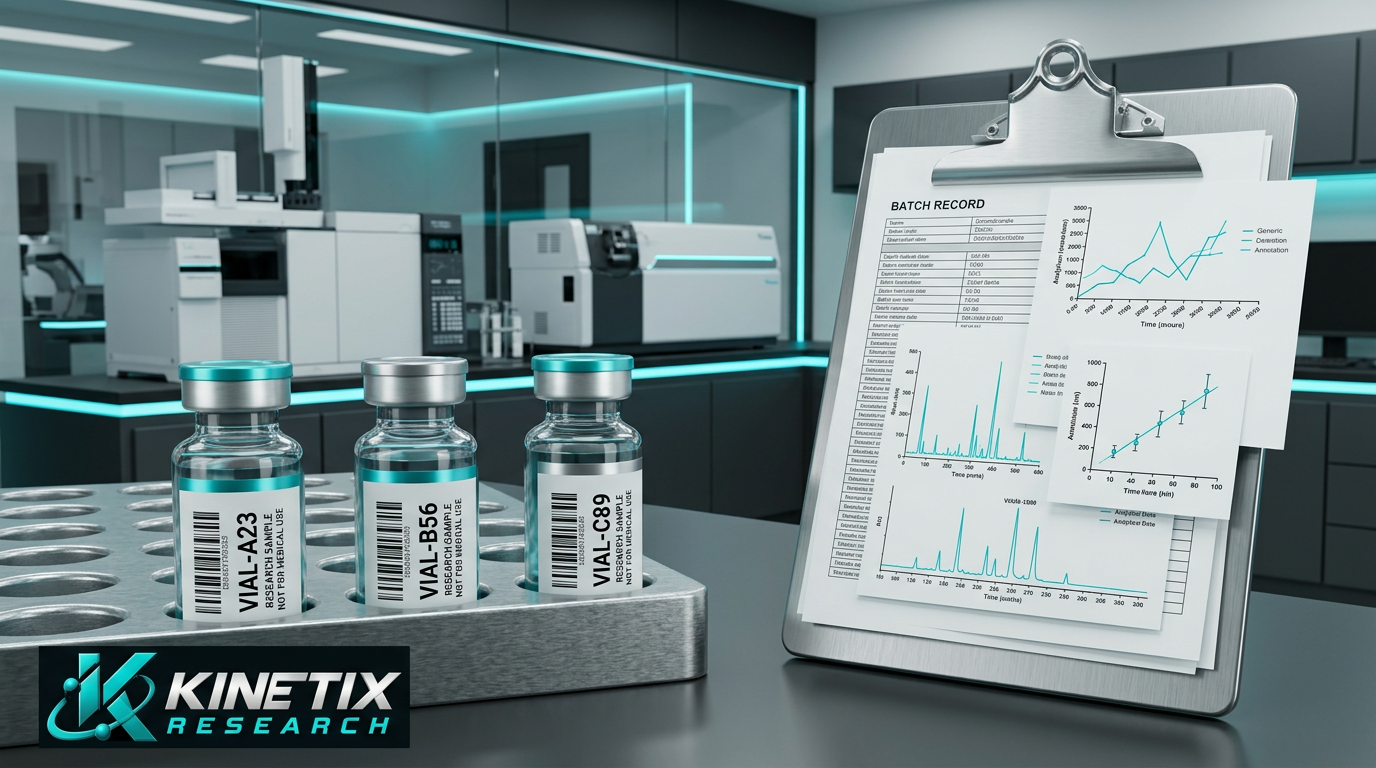
Why Doesn't a Certificate of Analysis Automatically Guarantee the Quality of Every Batch?
Understand why a Certificate of Analysis is sample- and lot-specific, how test scope and sampling matter, and what researchers should verify.

Analytical Testing
Understanding Peptide Purity: What the Percentage Does, and Does Not, Tell You
Purity figures are useful, but only when you know how they were measured and what they leave out.
Contact the Kinetix Team
Let's Talk Science.
Have a question about an article or a topic you'd like us to explore? Say Hi to the Kinetix Team.
Stay Updated on Research
Receive research insights, scientific updates, and educational resources from Kinetix Research.