
At What Point Does a Peptide Become a Protein?
By Kinetix Research Editorial Team · Published October 2, 2026 · Updated October 14, 2026 · 2 min read
Quick Answer
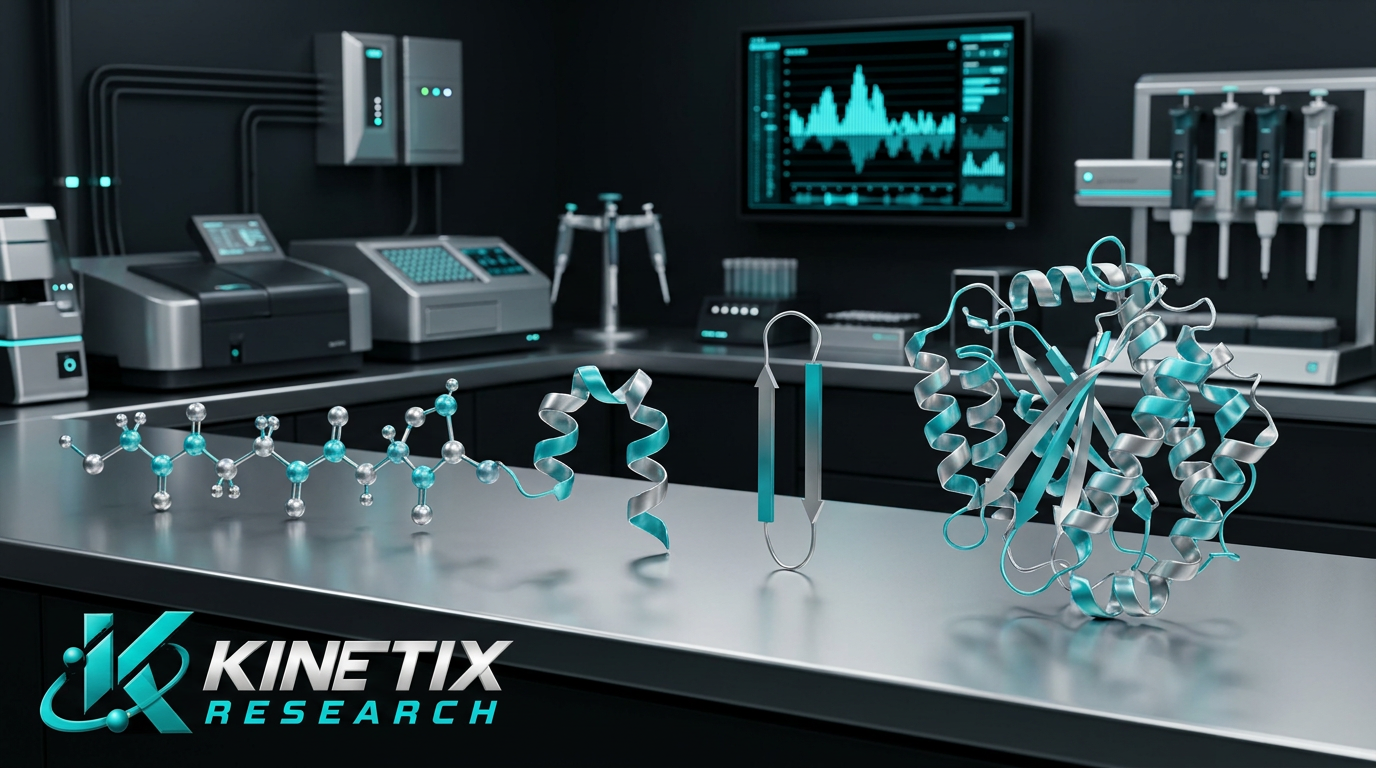
There is no exact universal point at which a peptide becomes a protein. Both contain amino acid residues linked by peptide bonds. Around 50 residues is a common teaching convention, not a chemical switch. Naming also reflects molecular size, structure, biological context and established usage; researchers should report the actual sequence and molecular characteristics rather than rely on the label alone.
Key Takeaways
- Peptides and proteins share the same basic backbone chemistry.
- The often-cited 50-residue boundary is conventional, not absolute.
- Folding or biological activity does not create a universal dividing line.
- A name cannot establish safety, quality or function.
Do peptides and proteins have different kinds of bonds?
Not as a general distinction. Both are built from amino acid residues connected through peptide bonds. Extending a chain by one residue does not suddenly create a new category of chemical linkage. The terminology describes a continuum of molecules rather than an abrupt physical transition.
Polypeptide is a useful term for a longer chain without forcing a sharp peptide/protein boundary. A protein may consist of one or several polypeptide chains, sometimes with attached groups or partner molecules. The exact composition is more informative than the category name when designing an experiment.
Why do many explanations mention 50 amino acids?
The National Human Genome Research Institute glossary describes peptides as short amino acid chains and uses fewer than 50 residues in its explanation. This gives beginners a workable distinction. It should not be interpreted as a rule that residue 50 or 51 changes a molecule's fundamental chemistry.
The IUPAC Gold Book instead describes proteins in terms of polypeptides with molecular weights greater than about 10,000 and explicitly notes that the limit is not precise. Molecular mass does not map to one fixed residue count because residues and modifications have different masses. The differing conventions show why context matters.
| Term | Typical meaning | Limitation |
|---|---|---|
| Peptide | A relatively short amino acid chain. | No universally applied maximum size. |
| Polypeptide | A chain of many linked amino acid residues. | Does not specify one exact chain length or function. |
| Protein | Usually a larger biological macromolecule made of one or more polypeptides. | Size boundaries and established naming are not perfectly uniform. |
Does folding or function settle the distinction?
Not by itself. Short peptides can form ordered structures and have biological roles. Proteins can contain flexible or intrinsically disordered regions rather than one rigid shape. The existence of a folded structure or a signaling function therefore does not supply a universal definition.
Established names can also persist across the boundary. Insulin, for example, has 51 residues distributed between two chains and is commonly discussed as a peptide hormone as well as a protein. Such usage reflects context, not a contradiction in its measured composition.
What should scientists report instead of debating the label?
- The actual amino acid sequence and chain lengths.
- Molecular mass, terminal groups and relevant modifications.
- Disulfide connectivity or multiple-chain composition when applicable.
- The structural and experimental context relevant to the research question.
For scientific interpretation, a precise description beats a rigid naming threshold. Neither peptide nor protein tells a reader whether the material is correctly identified, analytically characterized or suitable for a particular application. Those conclusions require their own evidence.
Frequently asked questions
Is every chain longer than 50 residues a protein?
Not under a universally accepted rule. Fifty residues is a common convention, while naming depends on context and established usage.
Can a short peptide have a biological function?
Yes. Some short peptides have specific biological roles; length alone does not determine function.
Is a polypeptide necessarily a complete protein?
No. Polypeptide describes a chain, while a protein may involve one or more chains and additional molecular context.
References
- Peptide: Genetics Glossary, National Human Genome Research Institute
- Proteins: IUPAC Gold Book, International Union of Pure and Applied Chemistry
- Biochemistry, Peptide, StatPearls / NCBI Bookshelf
Research Disclaimer. Kinetix Research content is for educational and informational purposes only. It is not medical advice and does not describe the safety or effectiveness of any product for human use. All Kinetix products are for research use only. See our scientific disclaimer and editorial policy.
Related research
Peptide Science
Peptides vs. Proteins: What’s the Difference?
How chain length, folding and terminology distinguish two closely related families of amino-acid molecules.
Peptide Science
What Are Peptides? A Beginner’s Guide to Peptide Science
An introduction to amino acids, peptide bonds and the difference between a molecular category and a proven treatment.
Peptide Science
If Two Peptides Have Exactly the Same Amino Acid Sequence, Can They Still Be Different?
Learn why peptide sequence alone may not capture stereochemistry, terminal modifications, cyclization, folding or differences in sample composition.
Contact the Kinetix Team
Let's Talk Science.
Have a question about an article or a topic you'd like us to explore? Say Hi to the Kinetix Team.
Stay Updated on Research
Receive research insights, scientific updates, and educational resources from Kinetix Research.