
Beyond the Label: Understanding Peptide Research, Purity, and Analytical Testing
By Kinetix Research Editorial Team · Published October 14, 2026 · 9 min read
Quick Answer
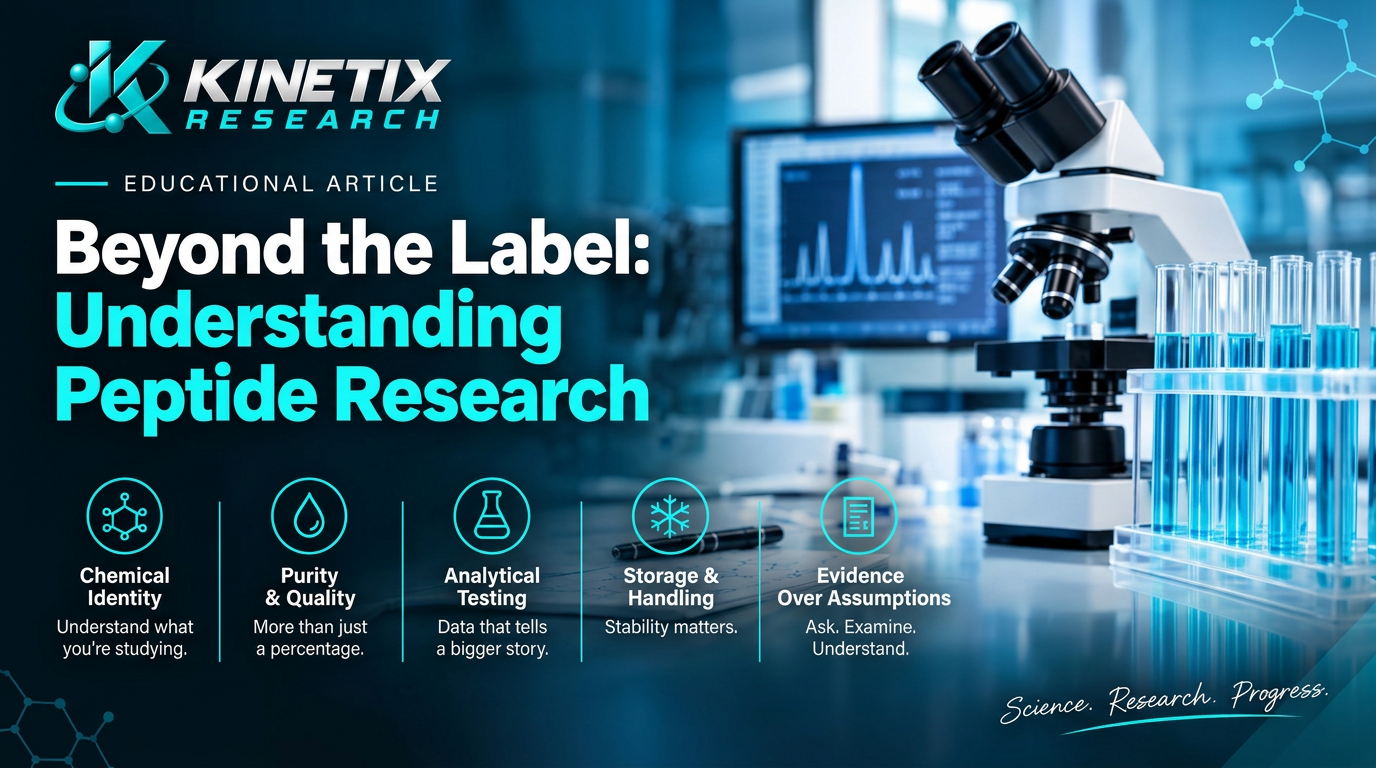
Peptide research is the scientific investigation of molecules made of amino acids joined by peptide bonds. Understanding a research peptide means looking beyond its label: chemical identity, purity, analytical methods such as HPLC and mass spectrometry, storage and stability, and the quality of documentation all matter. A high purity percentage alone does not prove identity, content, stability or safety.
Key Takeaways
- Chemical identity should be evaluated with analytical evidence, not inferred from a label.
- Purity is method-dependent and is not the same as identity, content or stability.
- HPLC separates components; mass spectrometry measures ions by mass-to-charge ratio; they are complementary.
- A Certificate of Analysis records specified tests, not universal proof of quality.
- Conclusions should stay within the scope of the available evidence.
Scientific research begins with curiosity, but meaningful conclusions depend on evidence. When researchers study peptides, understanding a compound involves more than recognizing its name or reviewing a single number on a laboratory report.
Chemical identity, sample composition, analytical methods, storage conditions, and the quality of supporting documentation all contribute to a more complete understanding of a research material.
As interest in peptide science continues to grow, learning how researchers evaluate laboratory data has become an important part of scientific literacy. At Kinetix Research, we believe that research education should encourage careful questions, transparent documentation, and evidence-based thinking.
In this guide, we explore the fundamentals of peptide research, explain how analytical testing works, and examine why purity results must be interpreted within their proper scientific context.
What is peptide research?
Peptide research is the scientific investigation of peptides, which are molecules made up of amino acids connected by peptide bonds. Amino acids are the building blocks used to form peptides and proteins. The number, sequence, and arrangement of amino acids influence a molecule's structure and chemical characteristics.
Researchers investigate peptides in various scientific fields, including biochemistry, molecular biology, analytical chemistry, and structural biology. Depending on the research question, investigations may focus on:
- Molecular structure and chemical composition.
- Interactions between molecules under controlled experimental conditions.
- Analytical methods used to identify and characterize samples.
- Stability and degradation under defined environmental conditions.
- The development and validation of laboratory measurement techniques.
Peptide research encompasses many different questions and methodologies. Consequently, findings from one peptide, experimental model, or analytical method should not automatically be applied to another. Understanding the specific research question is the first step toward interpreting any scientific result accurately.
Why does chemical identity matter in peptide research?
Chemical identity refers to what a substance actually is. In analytical science, establishing identity is fundamental because a sample's label or stated description is not, by itself, independent proof of its composition.
Researchers use appropriate analytical methods and reference data to investigate whether a sample's measured characteristics are consistent with the expected compound. Depending on the substance and research objective, characterization may involve examining molecular mass, chromatographic behavior, spectral data, or other relevant chemical properties.
How is a peptide's identity evaluated? The approach depends on the compound and the available analytical evidence. Mass spectrometry can provide information about molecular mass and, with suitable methods, structural features. Chromatographic techniques can help separate components within a sample. These techniques provide different kinds of information and may complement one another.
A single matching measurement may not be sufficient to establish every aspect of a molecule's structure. Researchers must consider the method's capabilities, limitations, reference standards, and the possibility of alternative explanations.
Key takeaway: Chemical identity should be evaluated using appropriate analytical evidence rather than inferred from a product name or label alone.
What does peptide purity mean?
Peptide purity describes the proportion of a sample attributed to the target compound under a specified measurement or analytical method. However, the term purity requires context. Different analytical techniques measure different properties, and the result can depend on how the sample is prepared, which method is used, and how the data are processed.
For example, a chromatographic purity result may describe the relative detector response associated with a principal peak compared with other detected peaks. That result is not necessarily equivalent to the sample's total mass fraction of the target substance.
Does a high purity percentage prove quality? No. A high reported purity percentage alone does not establish complete chemical identity, the absence of every possible contaminant, biological activity, stability, or safety. A meaningful assessment considers what was measured, how it was measured, and which limitations apply.
| Concept | What it describes |
|---|---|
| Chemical identity | Whether the material's characteristics support its assigned identity |
| Chromatographic purity | The distribution of detected chromatographic signals under a particular method |
| Assay or content | The amount of a specified substance measured using an appropriate validated method |
| Impurity profile | The detected additional components and their measured characteristics |
| Stability | How specified properties change over time under defined conditions |
These concepts are related, but they are not interchangeable. The correct interpretation depends on the analytical method and the question being investigated.
How do scientists test peptides? Understanding HPLC and mass spectrometry
Analytical testing helps researchers examine the characteristics and composition of scientific samples. Two widely used analytical technologies are high-performance liquid chromatography (HPLC) and mass spectrometry (MS). Although they can be used together, each has a distinct role.
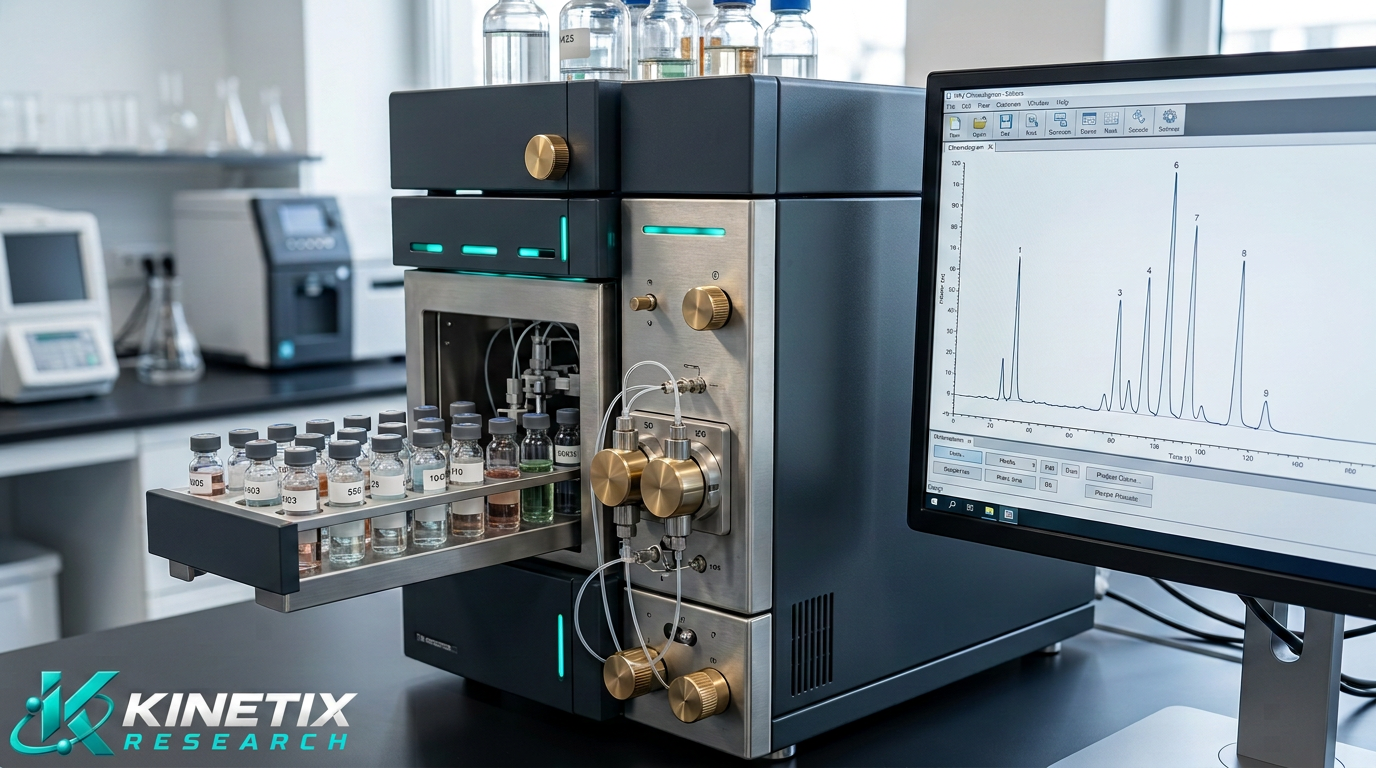
High-performance liquid chromatography (HPLC) separates components in a sample as they move through a chromatographic system under controlled conditions. A detector records signals as components emerge from the system, producing a chromatogram. Researchers may examine features such as:
- Retention times.
- Peak shapes and separation.
- Relative peak areas.
- Additional detected peaks.
- The suitability of the method for the intended analytical purpose.
Chromatographic data can help assess sample composition, but interpretation depends on the method and detector. Some substances may not be detected effectively, and different components may produce different detector responses. Consequently, a chromatogram should not be interpreted as a complete inventory of everything present in a sample.
Mass spectrometry (MS) measures ions according to their mass-to-charge ratios. Depending on the instrument and experimental approach, MS can provide information that supports molecular-mass assessment, compound identification, and structural characterization. Researchers may use techniques such as tandem mass spectrometry to investigate additional structural information.
However, a mass spectrum does not automatically establish every aspect of sample composition. Results must be interpreted in light of the analytical method, instrument performance, reference information, and other relevant evidence.
Why combine analytical techniques? Different methods answer different questions. Chromatography can separate components, while mass spectrometry can provide complementary information about their molecular characteristics. When appropriately designed, complementary techniques can strengthen an analytical assessment by reducing reliance on a single measurement. The choice of methods should follow the scientific objective, the properties of the compound, and the limitations of the available equipment.
Key takeaway: HPLC and mass spectrometry can provide valuable analytical evidence, but neither should be treated as an automatic guarantee of overall sample quality.
How should researchers interpret a Certificate of Analysis?
A Certificate of Analysis (CoA) is a document that reports specified analytical results for a material or sample. Depending on the organization and testing arrangement, a CoA may include the sample identification, test methods, measured results, acceptance criteria, and relevant dates. Its value depends on the information it contains and the reliability of the testing and documentation behind it.
When reviewing a CoA, researchers may consider the following questions:
- Is the sample clearly identified? Sample identifiers and batch or lot information can help establish traceability.
- Are the analytical methods described? Knowing which methods were used helps readers understand what the results can and cannot demonstrate.
- Are the results presented with appropriate context? A reported number is more informative when its units, measurement approach, acceptance criteria, and interpretation are clear.
- Is the testing traceable? The testing organization, report date, sample reference, and relevant quality documentation may help establish the provenance of the results. Independent testing can provide additional evidence when appropriately documented.
- Are the limitations acknowledged? No analytical report should be assumed to answer questions beyond the scope of the methods performed.
A CoA should therefore be interpreted as a record of specified testing, not as universal proof of every characteristic of a material.
Why do storage and stability matter?
Stability describes the extent to which a material retains specified properties over time under defined conditions. For research compounds, stability can be affected by factors such as temperature, moisture, light exposure, the surrounding chemical environment, and the physical state of the material. The importance of each factor depends on the particular compound and the conditions being studied.
A stability study evaluates selected characteristics at defined time points under specified conditions. Depending on the research objective, measurements may examine changes in chemical composition, degradation products, physical properties, or other relevant indicators. Good stability documentation identifies the conditions tested, the duration of observation, the analytical methods used, and the limits of the conclusions.
It is important not to assume that results from one compound establish stability conditions for another. Likewise, a single measurement at one point in time cannot independently establish long-term stability. Scientific conclusions should remain within the scope of the available data.
What makes scientific research evidence reliable?
Reliable scientific interpretation requires more than an interesting result. Researchers need to understand how the evidence was generated and whether the conclusions follow from the observations. Several principles help support a rigorous approach:
- Reproducibility: whether comparable findings can be obtained when an experiment or analysis is repeated under appropriately specified conditions. Clear methods and sufficient documentation help others assess this.
- Appropriate controls: controls help identify potential sources of error and distinguish the effect being investigated from other influences.
- Transparent reporting: reports should describe relevant methods, results, limitations, and uncertainties so readers can evaluate the strength of the evidence.
- Distinguishing observation from interpretation: an observation is what the data show; an interpretation explains what they may mean. Keeping these separate reduces unsupported claims.
- Independent verification: where appropriate, independent analysis or replication can help evaluate whether findings are consistent across different testing arrangements.
Together, these principles encourage careful reasoning and more dependable scientific communication.
Common misconceptions about peptide testing
- A high purity percentage proves everything about a sample. Purity is only one analytical consideration; identity, content, impurities, and stability may require different methods.
- One laboratory test can answer every question. Analytical techniques have specific capabilities and limitations.
- A Certificate of Analysis guarantees every aspect of quality. A CoA reports the results of specified tests; its scope does not automatically extend to untested characteristics.
- A published scientific finding applies to every peptide. Findings are specific to the material, methodology, experimental conditions, and research question.
- A measurement without context is sufficient evidence. Results require appropriate units, methods, reference information, and interpretation to be meaningful.
The future of peptide research: better questions, better evidence
Scientific progress depends on asking precise questions and interpreting results carefully. As analytical technologies continue to develop, researchers have more ways to investigate molecular characteristics, examine sample composition, and improve scientific documentation. Yet better instruments do not eliminate the need for sound experimental design, appropriate controls, transparent reporting, and critical interpretation.
The essential principles remain consistent: identify what is being measured, understand how the measurement was obtained, recognize its limitations, and ensure that conclusions are supported by the available evidence.
At Kinetix Research, our educational mission is to make complex research concepts easier to understand while encouraging scientific curiosity and responsible interpretation. Because meaningful research is not just about the numbers on a report. It is about understanding what those numbers actually tell us. Keep asking questions. Examine the evidence. Let science lead the conversation.
Educational disclaimer: This article is intended for general scientific and educational purposes. It does not constitute medical advice, establish the safety or efficacy of any compound, or recommend human or veterinary use. Analytical results and research findings must be interpreted within the scope and limitations of the methods and evidence available.
Frequently asked questions
What is peptide research used to investigate?
Peptide research investigates the chemical, structural, and other scientific properties of peptides. Depending on the field, researchers may examine molecular interactions, analytical characterization, stability, and experimental behavior under controlled conditions.
What is peptide purity testing?
Peptide purity testing uses an appropriate analytical method to assess the target compound relative to other detected components or according to a defined measurement procedure. The meaning of a result depends on the method, detector, and reporting approach.
Is HPLC enough to confirm peptide identity?
Not necessarily. HPLC can separate components and provide useful chromatographic information, but retention time or peak area alone may not establish complete chemical identity. Additional analytical evidence may be appropriate.
What is the difference between HPLC and mass spectrometry?
HPLC separates components in a sample, while mass spectrometry measures ions according to their mass-to-charge ratios. The techniques provide different information and can be complementary when used together.
What does a Certificate of Analysis tell researchers?
A CoA documents specified analytical tests and their results for an identified sample. Its usefulness depends on sample traceability, method documentation, the scope of testing, and the reliability of the underlying data.
Does a purity result establish safety?
No. A purity measurement alone cannot establish safety, suitability for a particular use, or biological effects. Those questions require evidence appropriate to the specific context.
Why is stability testing important in laboratory research?
Stability testing examines how selected material properties change over time under defined conditions. It helps researchers understand the limits of the data and whether the observed characteristics remain consistent within the study's scope.
How can readers evaluate peptide-related scientific claims?
Readers should examine the original evidence, identify the methods used, consider the study's limitations, distinguish measured results from interpretations, and avoid generalizing beyond the conditions investigated.
References
- ICH Q2(R2): Validation of Analytical Procedures, International Council for Harmonisation
- ICH Q1A(R2): Stability Testing of New Drug Substances and Products, International Council for Harmonisation
- General Chapter <621> Chromatography, United States Pharmacopeia
Research Disclaimer. Kinetix Research content is for educational and informational purposes only. It is not medical advice and does not describe the safety or effectiveness of any product for human use. All Kinetix products are for research use only. See our scientific disclaimer and editorial policy.
Related research
Analytical Testing
What Is HPLC Testing? A Plain-Language Guide for Peptide Research
How high-performance liquid chromatography separates a sample, what a chromatogram shows, and where its limits are.

Analytical Testing
Understanding Peptide Purity: What the Percentage Does, and Does Not, Tell You
Purity figures are useful, but only when you know how they were measured and what they leave out.

Research Documentation
How to Read a Certificate of Analysis (CoA)
A section-by-section walkthrough of the document that records a batch's test results.
Contact the Kinetix Team
Let's Talk Science.
Have a question about an article or a topic you'd like us to explore? Say Hi to the Kinetix Team.
Stay Updated on Research
Receive research insights, scientific updates, and educational resources from Kinetix Research.